Hydrotreating Units, Revamps & CS2 Removal
More capacity, better product quality and lower capital cost, with a DWC Prime option that can avoid the revamp altogether.
DWC Innovations designs new hydrotreating units and revamps existing facilities to increase capacity, improve product quality and reduce capital investment. Whether the objective is higher throughput, additional spare capacity, tighter sulfur specifications or better catalyst performance, we develop practical solutions tailored to refinery and petrochemical operations.
In many cases, conventional thinking points to a larger hydrotreater. DWC Innovations evaluates the entire process first. For selected applications, a DWC Prime™ column upstream of the hydrotreater can substantially reduce the treating load and eliminate the need for a major hydrotreater revamp.
Hydrotreating Services
New Hydrotreating Units
Complete process design for grassroots hydrotreating units, including feed and product specifications, reactor design, separation systems, equipment sizing and utility requirements.
Revamps and Capacity Expansion
Increase throughput or build spare capacity through reactor debottlenecking, heat-integration improvements, exchanger upgrades, charge-heater modifications and fractionation revamps.
Catalyst Optimization
Independent catalyst evaluation, selection and reload strategies to maximize activity, extend cycle length and increase processing capacity.
DWC Prime Pre-Treatment Solutions
For selected services, a DWC Prime™ column can remove or concentrate contaminants ahead of the hydrotreater, significantly reducing treating load and avoiding costly unit expansions.
Sometimes the best hydrotreater revamp is avoiding the revamp entirely.
How DWC Prime Eliminated the Need for a Hydrotreater Expansion
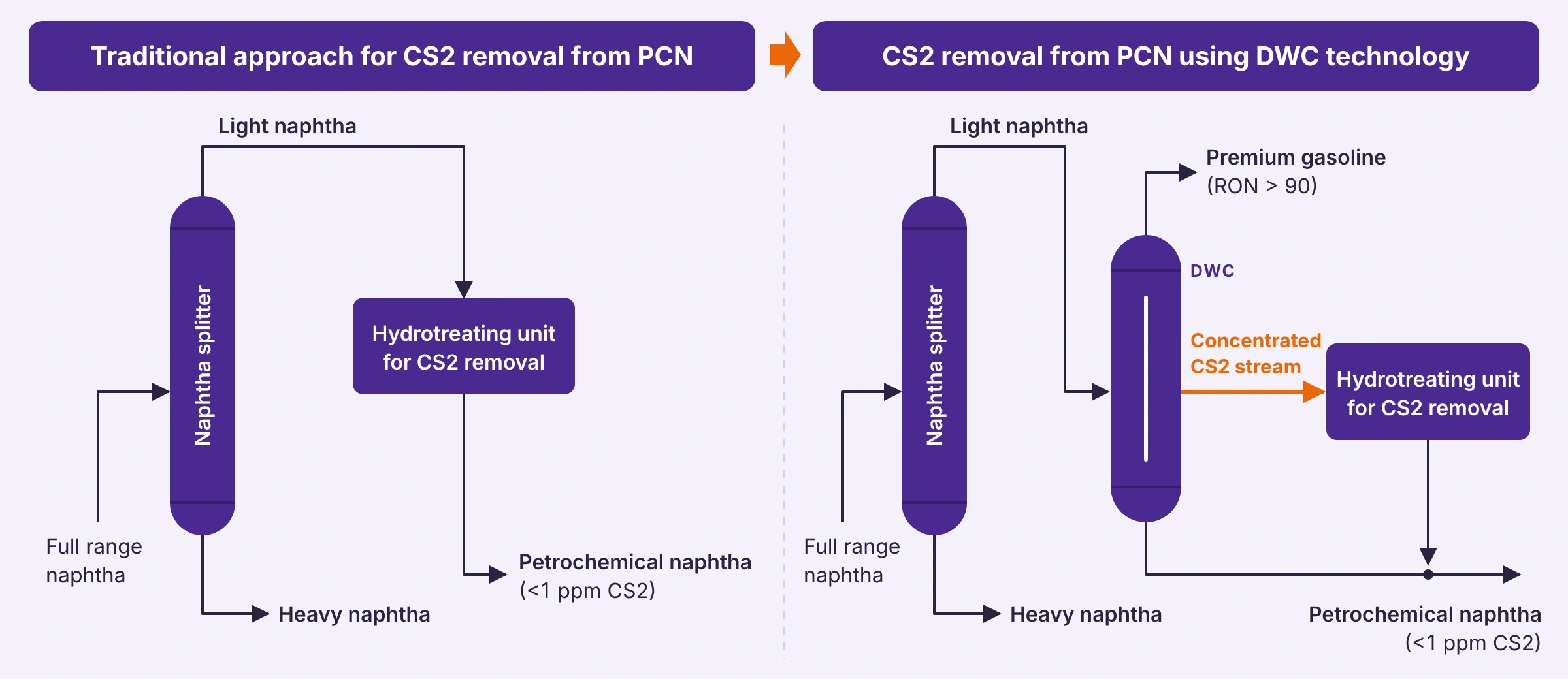
A refiner needed petrochemical naphtha with less than 1 ppm carbon disulfide (CS2), which corrodes downstream cracker units and poisons hydrogenation catalysts. The conventional route was a bigger hydrotreater for the full stream. A DWC Prime retrofit of the existing depentanizer did the job instead, in three steps.
Revamp the existing column
The depentanizer or naphtha splitter is converted to DWC Prime inside its existing shell.
Concentrate CS2 in a side draw
The dividing wall collects the CS2 into a small side stream.
Hydrotreat the side cut only
Only that side cut goes to the naphtha hydrotreater. On-spec petrochemical naphtha leaves the column directly.
Why Refiners Choose DWC Prime for CS2 Removal
Avoid Major Hydrotreater Investments
The existing hydrotreater processes only a small CS2-rich side stream rather than the entire naphtha feed, eliminating the need for a larger reactor and associated equipment.
Increase Hydrotreater Capacity
Treating only the concentrated impurity stream frees capacity for additional refinery feeds and future production growth.
Create Additional Revenue
The iC5-rich overhead stream is recovered as premium gasoline, generating incremental product value.
Reduce Energy Consumption
The DWC Prime configuration operates with low-pressure steam and lower utility requirements than conventional alternatives.
Lower Capital Cost
Retrofitting an existing column typically requires significantly less investment than adsorption systems or a complete hydrotreater expansion.
Learn more about Dividing Wall Column technology →
Successful Commissioning of DWC Prime Column to Meet New CS2 Regulation for Petrochemical Naphtha
DWC Innovations commissioned a DWC Prime™ column at a major Southeast Asian refinery. Retrofitted into the existing depentanizer, it produces petrochemical-grade naphtha with less than 1 ppm CS2, plus premium gasoline as an additional product, without a new standalone processing unit.
Cut CS₂ below 1 ppm — without a new unit
See how a DWC Prime revamp of the existing depentanizer takes petrochemical naphtha below 1 ppm CS₂ — and turns the light overhead into a premium-gasoline stream, without a new column or a full-stream hydrotreater.

Planning a new hydrotreater or a revamp?
Talk to our engineers about new units, revamps, spare capacity and catalyst change-outs, and whether a DWC Prime design can save the revamp altogether.