Extractive Distillation DWC Technology
Difficult separations. Fewer columns. Lower energy. EDWC Prime™ combines the extractive column and the solvent recovery column in one shell, reducing energy use, equipment count and project cost.
The problem
Two Columns, Two Reboilers, One Hot Solvent Loop
Extractive distillation separates close-boiling and azeotropic mixtures by adding a high-boiling solvent that shifts relative volatility. A conventional unit needs two columns: an extractive column that takes the raffinate overhead, and a solvent recovery column that strips the extract from the solvent.
The solvent is heated, cooled and reheated as it moves between the two. Each transfer adds duty, exchangers, piping and plot space. An extractive dividing wall column does both jobs in one shell.
Is it right for you?
When Does EDWC Prime Make Sense?
Many extractive distillation projects grow into a train of columns with high energy use and significant capital cost.
Not sure what limits your unit today? Start with distillation troubleshooting or a feasibility study.
- Plain distillation cannot make the separation economically
- The mixture is close-boiling or forms an azeotrope
- An existing extractive unit uses too much energy
- The separation needs an extractive column and a solvent recovery column
- Plot space for new equipment is limited
- The project needs both solvent-assisted separation and process intensification
Why it matters
Benefits of EDWC Prime
- Lower energyOne reboiler replaces two, and the solvent is no longer heated, cooled and reheated between columns, so utility use falls compared with a conventional extractive scheme.
- Lower capexOne shell, fewer exchangers, less piping and a smaller plot.
- Less solvent stressSmaller solvent inventory and shorter hot residence time, which reduces solvent degradation.
- Revamp potentialAn existing extractive or recovery column can be assessed for conversion where its diameter and hydraulics allow.
Applications
Where EDWC Prime Fits
- Aromatics recoveryBenzene, toluene and xylenes from reformate or pyrolysis gasoline, with solvents such as sulfolane, NMP or NFM.
- C4 separationButadiene and butene recovery from mixed C4 streams with NMP, DMF or acetonitrile.
- Solvent recovery and azeotrope breakingAlcohol–water, THF–water, acetone–methanol and ketone purification duties in chemicals and pharma, where plain distillation becomes impractical.
- Close-boiling hydrocarbonsSeparations where relative volatility is too low for plain distillation to be economic.
How it works
Both Steps in a Single Shell
- Extractive sideFeed and solvent enter on one side of the wall. The solvent carries the extract component down; the raffinate leaves overhead on that side.
- Extract sideThe wall runs up to the top head. On the other side, the extract component is rectified and taken overhead as a high-purity product.
- Common bottomA shared stripping section and a single reboiler release the extract from the solvent. Lean solvent leaves the bottom and is recycled, with a small makeup stream to cover losses.
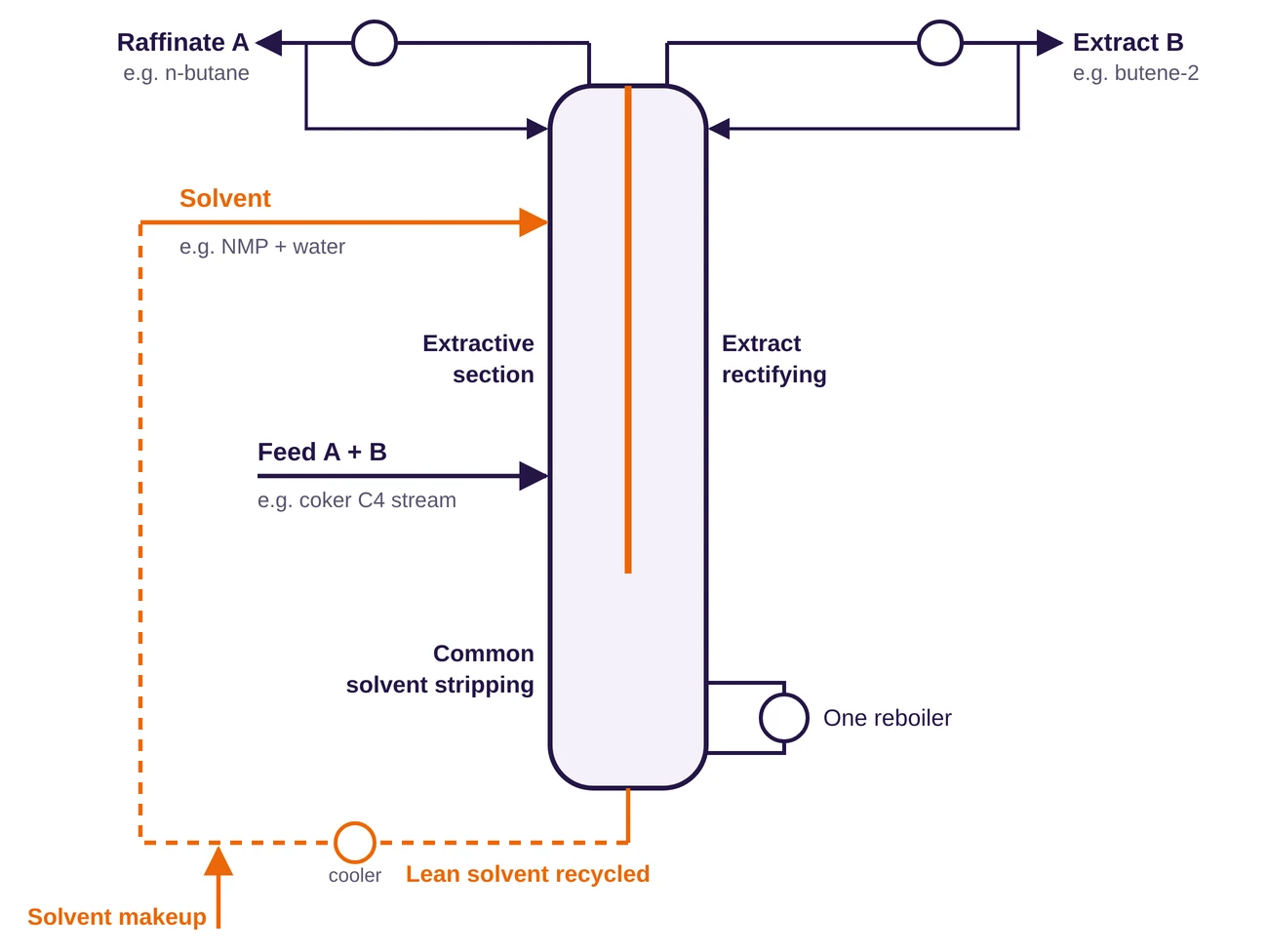
EDWC Prime vs Conventional Extractive DistillationView the comparison
| Conventional extractive distillation | EDWC Prime | |
|---|---|---|
| Columns | Two: extractive column and solvent recovery column | One shell with a top dividing wall |
| Reboilers | Two | One, shared stripping section |
| Solvent handling | Heated, cooled and reheated between columns | Stays in one shell |
| Exchangers, pumps and piping | A full set for each column | Fewer auxiliaries |
| Plot space | Two columns and their equipment | One column footprint |
Proven platform
Built on Proven DWC Prime Technology
Columns commercialized worldwide
Delivered across refining and petrochemical complexes — and we stay on as a long-term partner through design, delivery and start-up.
World’s first multi-column DWC network
Four DWC Prime columns replaced a full seven-column conventional distillation train at an Indian acetone-derivatives complex.
One technology platform
Part of the DWC Prime Family
DWC Prime™
Replace multiple conventional columns with one.
Dual DWC Prime™
Produce more products from a single shell.
EDWC Prime™
Solve difficult solvent-assisted separations with fewer columns and lower energy use.
See the projects behind the platform in our DWC case studies.
Questions & Answers
Extractive Dividing Wall Columns, Explained
Can’t find your answer? Ask our engineers →
What is extractive distillation?
A separation in which a high-boiling solvent is added to change the relative volatility of the components. It is used where plain distillation fails or is uneconomic — azeotropes and close-boiling mixtures.
What is an extractive dividing wall column?
A single column that does the work of the extractive column and the solvent recovery column. A top dividing wall separates the extractive section from the extract rectifying section, and both share one stripping section and one reboiler.
Why use EDWC Prime instead of conventional extractive distillation?
It replaces the conventional two-column scheme, which cuts the equipment, energy use and plot space needed for the same separation.
Is EDWC Prime commercially proven?
EDWC Prime builds on the same dividing wall column platform used in more than 25 commercial DWC installations worldwide. Each extractive application is evaluated individually through a feasibility study and process simulation before any commitment.
Which solvents can be used?
The same solvents used in conventional extractive units — for example sulfolane, NMP, NFM, DMF, acetonitrile and glycols. Solvent choice and solvent-to-feed ratio are set during the feasibility study.
Can an existing extractive unit be revamped?
Often, yes. Whether an existing shell can take a wall depends on its diameter, tray or packing hydraulics and the required product purities. We confirm this in a feasibility study before any commitment.
How do we start?
Send us your feed composition, solvent, product specifications and current energy use. We return a feasibility study with the configuration, savings and payback.
Have a difficult separation challenge?
Not every problem needs more columns. Send us your separation challenge and we’ll evaluate whether EDWC Prime can reduce equipment, energy use and cost, before you commit.