Dual Dividing Wall Column – DWC Prime
Four or more high-purity product streams from a single shell — combining three or more conventional columns into one column for a smaller footprint and lower capital cost.
Dual DWC Prime · DDWC
What Is a Dual Dividing Wall Column?
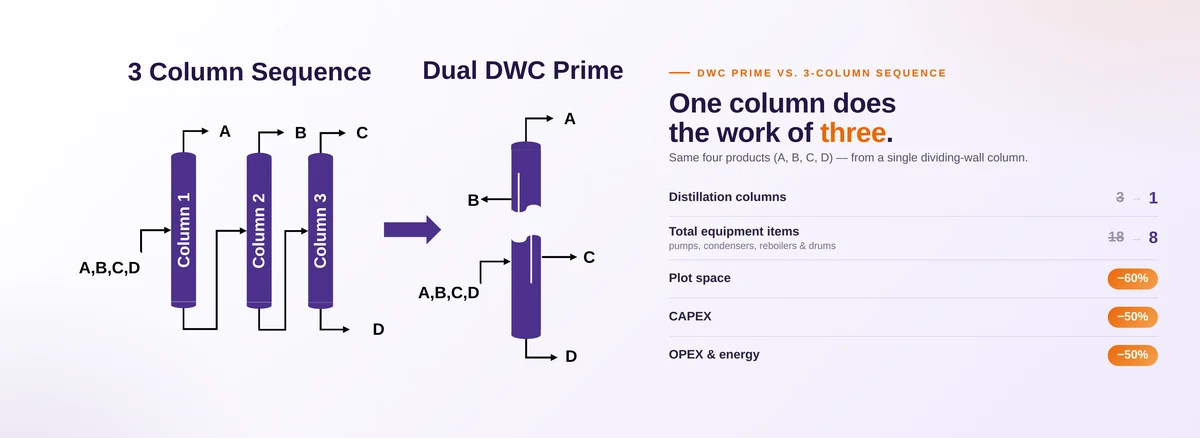
Dual DWC Prime (DDWC Prime) extends our process-intensification portfolio a step further than a standard single-wall dividing wall column. Instead of merging two columns into one shell, DDWC Prime merges three or more conventional columns into a single shell, delivering four or more high-purity products from that one shell. Because it consolidates more separation duty into a single piece of equipment, DDWC Prime reaches an even higher thermodynamic efficiency than a single-wall DWC.
How it works
Several walls, one shell
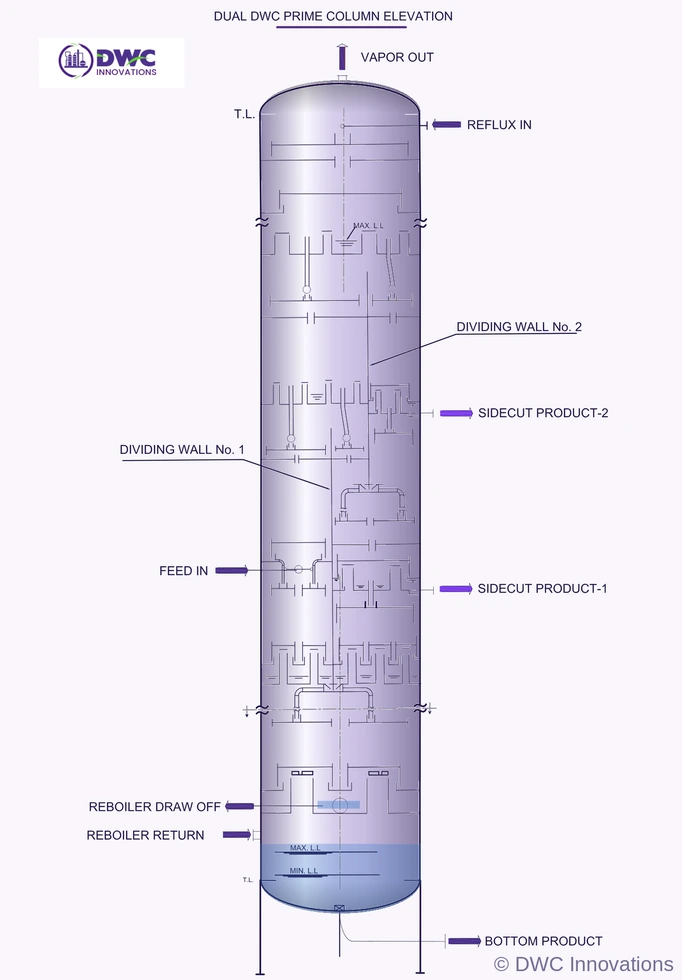
From the outside, a dual dividing wall column looks like an ordinary dividing wall column. Inside, it carries more than one partition — sometimes overlapping, at a single elevation or at several — so one shell does the work of three or more conventional columns.
- Walls placed where the separation needs themMultiple partitions at one elevation or several, sized to the duty.
- Simple liquid and vapour splitsThe layout keeps the internal splits easy to set and control — the key to building and running it.
- Robust and flexible in operationStable and straightforward to run despite the extra separation it performs.
Why it matters
Key Benefits
- Three or more columns, one shellCombines three or more conventional distillation columns into a single shell.
- Four or more on-spec productsProduces four or more high-purity product streams from that one shell.
- Higher efficiency than a single-wall DWCDelivers higher thermodynamic efficiency than a single-wall DWC.
- Simple liquid and vapour splitsMultiple walls, single or multi-level, keep liquid/vapor splits simple to control.
- Robust and easy to operateRobust, flexible and easy to operate despite the added internal complexity.
- Smaller plot, lower capex, shorter turnaroundsLower footprint, reduced capital cost and shorter turnaround versus separate columns.
Applications
Applications of Dual DWC Prime
Dual wall columns are used primarily in large columns and span a wide range of applications — including isomerization, aromatics and lube-oil processing. Below are DDWC Prime projects DWC Innovations has executed.
3-Cut DIH → 4-Cut DDWC Prime
Unlock high-value C6 products from existing isomerization units. DWC Prime upgrades a three-cut DIH into a four-cut system producing valuable C6 products — boosting feed capacity, preserving RON, cutting energy use, adding new revenue, and delivering a fast 2–10-month payback.
LOBS Unit Revamp with Multi-Cut Separation
A DDWC Prime column produced five lubricating-oil grades in a single shell, improving product recovery, cutting energy use, and eliminating the need for three separate columns — reducing plot space and simplifying operations.
Naphtha Splitter
Naphtha splitter was upgraded to a Dual DWC Prime column, delivering sharper three-cut separation, higher-purity light, medium and heavy naphtha streams, enhanced operational flexibility and stable control — all achieved with no increase in reboiler duty and minimal changes to existing equipment.
Proven in the field
The only commercial dual-DWC track record
Commercial dual DWCs delivered
BPCL Mumbai, MRPL and CPCL, plus two dual-wall DWCs at a chemical complex in India.
Columns replaced by one DWC network
Four DWC Prime columns, two of them dual DWCs, now do the work of a seven-column separation train.
Press releases
Commissioned Around the World
Press Release
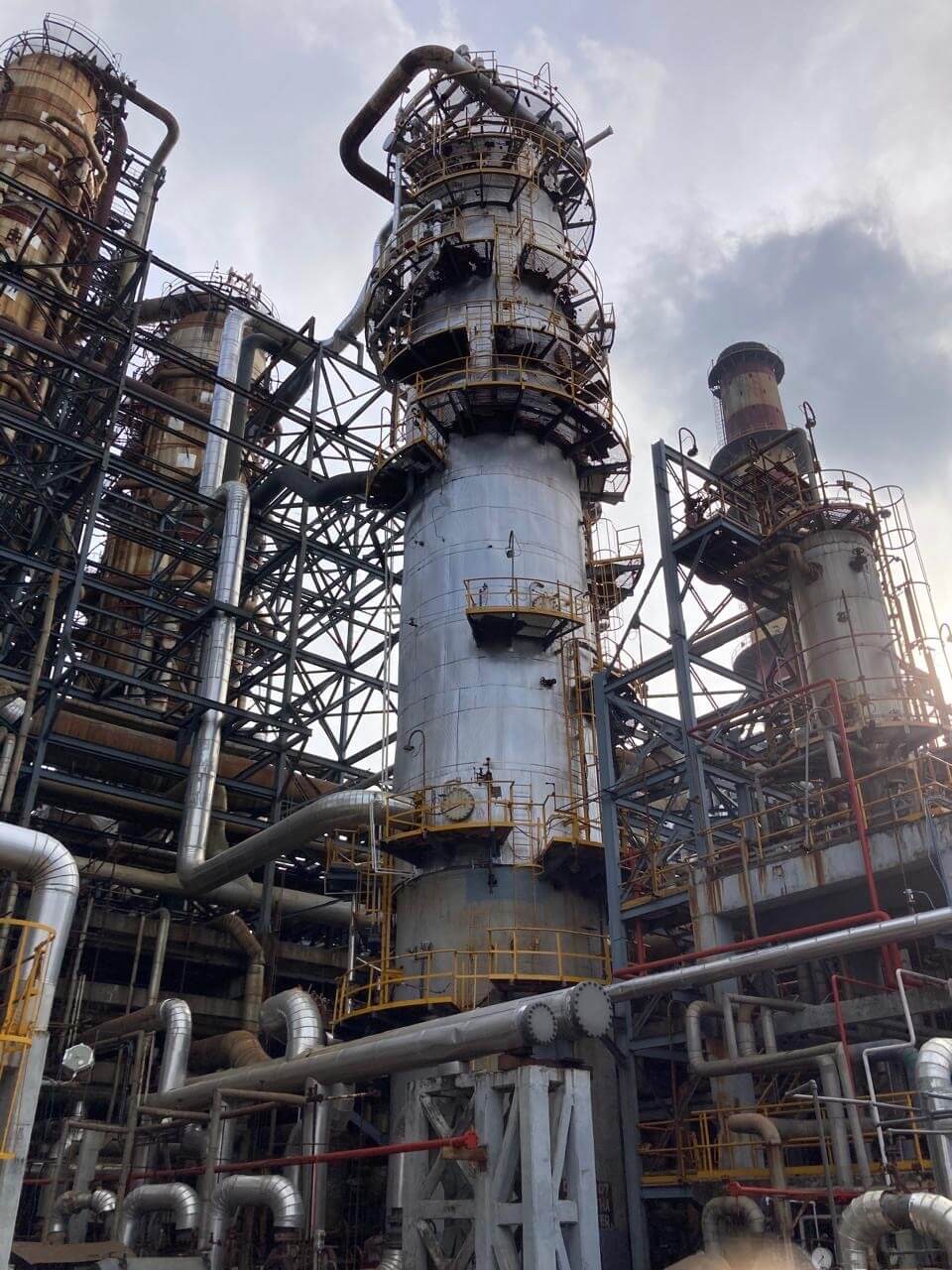
Successful Revamp of Naphtha Splitter Column to Dual DWC at MRPL, India
July 9, 2026
Read release →

Questions & Answers
Dual and Multiple Dividing Wall Columns, Explained
Beyond the dual layout, DWC Prime also engineers multiple dividing wall column configurations — placing more than one dividing wall within a single shell to combine three or more conventional towers into one column. Whether a dual or a multiple dividing wall column best fits the separation, the objective is the same: fewer vessels, a smaller plot footprint, and lower capital and energy cost.
Can’t find your answer? Ask our engineers →
What is a dual dividing wall column (dual DWC)?
It’s one column doing the work of three or more. Where a standard DWC uses a single internal wall to split a feed into three products, a dual DWC (DDWC Prime) uses more than one wall to deliver four or more high-purity cuts from the same shell — at even higher thermodynamic efficiency.
How is a dual DWC different from a standard single-wall DWC?
Scale. A single-wall DWC combines two columns and makes three products; a dual DWC combines three or more and makes four or more, all in one vessel. Packing that much separation into a single shell is what lifts efficiency beyond a single-wall DWC — and it’s why dual DWCs are used mainly on large, multi-product duties.
Has anyone actually built a commercial dual DWC?
Yes — and to date, DWC Innovations is the only company with commercial experience in dual dividing wall columns. It has delivered five commercial dual DWCs: the world’s first commercial dual DWC at BPCL Mumbai, units at MRPL and CPCL, and two dual-wall DWCs at a chemical complex in India.
Why does DWC Innovations’ commercial dual-DWC experience matter?
Dual DWCs are far more complex than single-wall columns, and the gap between a paper design and a stable, on-spec commercial unit is where most attempts fall short. DWC Innovations has closed that gap in the field across five commercial dual DWCs — so you are working with the only proven commercial track record for this technology, not a first-of-a-kind experiment.
What can a dual DWC do that a single-wall DWC cannot?
Because it merges three or more columns into one shell and yields four or more products, a dual DWC handles multi-cut separations a single-wall DWC cannot — for example upgrading a 3-cut deisohexanizer to a 4-cut DDWC, multi-cut LOBS (lube oil base stock) unit revamps, and complex naphtha splitters — with a lower footprint and capital cost than the equivalent train of separate columns.
Which applications suit a dual DWC best?
The sweet spot is any separation that would otherwise take a train of columns to hit several on-spec products — for example a 3-cut DIH upgraded to a 4-cut unit, multi-cut LOBS revamps, and naphtha splitters. If you need multiple high-purity cuts but want to avoid the footprint, cost and energy of separate columns, it fits.
Can a dual DWC produce specialty or very high-purity products?
Yes. At CPCL, DWC Innovations commissioned a dual dividing-wall deisohexanizer that produces pharma-grade hexane — demonstrating that a dual DWC can meet demanding, high-value purity specifications in commercial operation.
Are dual DWCs difficult to operate given the added internal complexity?
No — operability is engineered in from the start. More walls do add internal complexity, but the layout is designed for stable, predictable behaviour, and every unit ships with a control scheme validated in dynamic simulation — so it runs as steadily as a conventional column across its full range.
What does DWC Innovations deliver on a dual DWC project?
The full scope — feasibility and process design, simulation and modelling, basic/feed and detailed engineering, locally manufactured internals, and complete project management through commissioning — backed by the only commercial dual-DWC track record in the industry.
Want to Integrate Dual DWC Prime Into Your Project?
Talk to our engineers about applying dual dividing wall column technology to your process.
