Dividing Wall Column – DWC Prime
High-purity multicomponent separation delivered in a single column — reducing footprint, capital cost, and energy use.
What it is
Reinventing distillation with the Dividing Wall Column
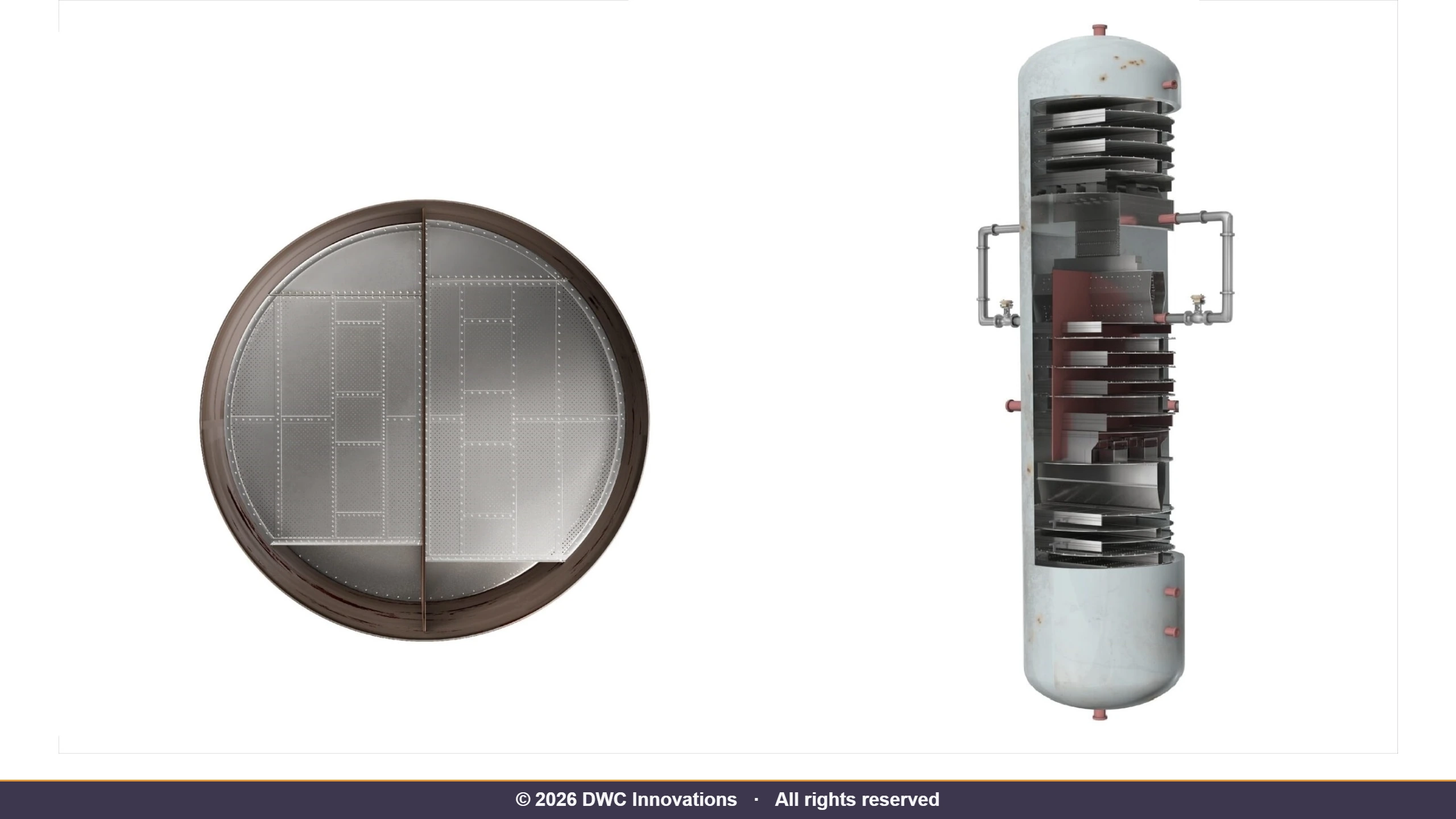
A dividing wall column (DWC) is a distillation column with a vertical wall inside. The wall splits the middle of the shell into two sections, so one column does the work of two or more conventional columns.
DWC Prime is DWC Innovations’ dividing wall column technology. It is built to retrofit existing refinery and petrochemical columns, either on its own or as part of a larger project.
- Single-wall
- Multi-wall
- Multi-column networks
- Retrofit-ready
Why it matters
Benefits of DWC Prime Dividing Wall Column
- Sharper, higher-value cutsSplits a multicomponent feed into three or more high-purity products in one shell, upgrading low-value streams into premium products.
- More capacity, same shellDelivers major capacity uplift without adding new columns — ideal for revamping side-cut columns that require high purity across all product streams.
- Fewer columns, smaller plotOne DWC replaces several conventional columns, leaving less equipment to buy, install and maintain.
- Lower energy useCuts energy consumption with minimal changes to external equipment.
- Downstream debottleneckingDebottlenecks downstream units including Isomerization, CCR, Para-Xylene, and Aromatics Recovery (ARU).
- Fast paybackLower capital and operating cost, with modifications usually confined to the column internals.
- Shorter turnaroundsLowers turnaround time and miscellaneous maintenance costs.
Reboiler duty, two columns → one
The wall removes the remixing between the two columns — that recovered 19.2 MMkcal/h is 92,494 t CO₂e a year.
Carbon screening
What does the energy saving weigh in carbon?
Put in the reboiler duties you run today. See the CO₂e a dividing wall avoids each year, what that saving is worth, and how it measures against a whole refinery.
Proven in the field
A Proven Track Record
Columns commercialized worldwide
Delivered across refining and petrochemical complexes — and we stay on as a long-term partner through design, delivery and start-up.
World’s first multi-column DWC network
Four DWC Prime columns replaced a full seven-column conventional distillation train at an Indian acetone-derivatives complex.
Why choose DWC Prime
A Complete Package, End to End
From project feasibility to installation, DWC Prime brings the full scope of process, control, manufacturing and project expertise under one roof.
Process evaluation and design
DWC Prime delivers a full-scope solution: starting with a critical evaluation of process requirements, then providing a complete, optimized process design tailored for smooth, reliable operation.
Robust control scheme
Every DWC Prime system is backed by control strategies developed from extensive dynamic simulation — from conventional control loops to advanced process control, depending on complexity.
Local manufacturing of internals
Column internals are manufactured locally, shortening delivery schedules and lowering project cost.
Energy optimization expertise
DWC Prime brings deep experience in energy-efficient design. Many installations integrate heat loads with upstream or downstream units, reducing overall utility consumption.
Complete project management
Team DWC handles the entire execution: detailed engineering, procurement, fabrication, site installation, and commissioning — all delivered to the highest standards of customer satisfaction.
Configurations
Dividing Wall Column Layouts in Common Use
DWC Prime places the dividing wall where the separation needs it. Three field-proven arrangements cover the most common duties.

DWC Prime Column
A single central dividing wall turns one shell into a prefractionator plus a main section, delivering three on-spec cuts — overhead, a side product and bottoms — with one reboiler and one condenser.
 ⤢ Inside the column
DWC Prime in a Side-Cut Column
A dividing wall added to an existing side-cut column lets the side draw come off as a true on-spec product.
- Improved product specifications
- Increased throughput
- Reduced dimensions for a grassroots column

⤢ Inside the columnTop Dividing Wall Column
The dividing wall sits in the upper (rectifying) section, producing two high-purity overhead products alongside a shared bottoms — ideal when the two lightest cuts must be split cleanly.
- Lower footprint
- Robust and flexible — liquid and vapour splits adjustable on either side of the wall
- Extra source for overhead heat integration
 ⤢ Inside the column

Bottom Dividing Wall Column
The dividing wall sits in the lower (stripping) section, yielding two distinct bottoms products under a shared overhead — suited to separating the two heaviest cuts.
- Replaces columns arranged in an indirect sequence
- Robust and flexible — three or more high-purity products
 ⤢ Inside the column
Applications
Where DWC Prime Delivers the Biggest Wins
The results below come from DWC Innovations’ application whitepapers, across the naphtha block, isomerization units and petrochemical service.
Distillation columns eliminated
DWC Prime replaces entire multi-column distillation trains with a compact, high-efficiency network — cutting the number of columns required by around 45%.
Naphtha splitter capacity
Revamps lift splitter capacity by more than 40%, with changes limited mainly to internals.
Deisohexanizer payback
DIH revamps typically pay back in 2–12 months, while increasing isomerization-unit throughput by 20%+.
Petrochemical naphtha (CS₂ removal)
A single retrofit depentanizer delivers C6+ bottoms with <1 ppm CS₂, meeting petrochemical-naphtha specifications and producing premium gasoline as a coproduct.
Reformate & aromatics feed splitters
A concentrated C6 mid-cut reduces feed to downstream aromatics extraction or benzene saturation by 27%, raising benzene concentration and routing lighter/heavier cuts directly to gasoline blending.
Depropanizer / propylene splitters
DWC Prime revamps increase throughput by ~30% while improving propylene recovery.
C6 products from an existing DIH
DWC Prime converts a conventional 3-cut DIH into a 4-cut column, unlocking valuable additional C6 products such as FGH, PGH, isohexane, and SBP solvents.
What is a dividing wall column (DWC)?
A DWC places a vertical partition inside a single distillation shell, so one column can separate a multicomponent mixture into three or more high-purity product streams — work that conventionally requires two or more columns in series. The concept has existed since the mid-1940s and keeps gaining ground because it delivers lower capital investment and lower operating costs than conventional arrangements.
What is DWC Prime, and how is it different from a standard DWC?
DWC Prime is DWC Innovations’ proprietary dividing wall column technology, built on innovative in-house designs that make the economics even more lucrative. It covers a wide spectrum of implementations — from single-wall, three-product columns to dual and multi-wall DWCs and multi-column networks — including complex DWCs that deliver ppm-level product purities, all under single-point accountability from design through delivery.
How much can DWC Prime actually save?
It varies with the duty, but the pattern holds: because one DWC does the work of several conventional columns, most revamps land in the 20–50% range on combined operating and capital cost. Those savings come from three levers together — fewer columns and a smaller plot, lower energy use, and changes confined mostly to internals rather than new equipment. The application figures above show where they have landed on real projects.
Is DWC technology commercially proven, or still experimental?
It is firmly commercial. The DWC Innovations team has commercialized more than 25 dividing wall columns worldwide over two decades of refining and petrochemical projects — including the world’s first commercial dual DWC (BPCL Mumbai), a turnkey naphtha-splitter dual DWC (MRPL Mangalore), and a dual DWC deisohexanizer (CPCL).
Can DWC Prime revamp existing columns, or only new units?
Both — but revamps are a particular strength. An existing side-cut or naphtha-splitter column can be converted to DWC to lift capacity by more than 40%, with changes limited mainly to internals. Deisohexanizer (DIH) revamps typically pay back in 2–12 months while increasing isomerization-unit throughput by 20%+.
Which separations and units benefit most from DWC Prime?
The biggest wins are across the naphtha block, isomerization units, and petrochemical service — naphtha splitters, deisohexanizers, reformate and aromatics feed splitters, and depropanizer/propylene splitters. DWC Prime also debottlenecks downstream units such as Isomerization, CCR, Para-Xylene, and Aromatics Recovery (ARU).
Can a DWC remove trace contaminants like CS₂ from petrochemical naphtha?
Yes. A DWC Prime revamp can reduce carbon disulphide (CS₂) in petrochemical naphtha to below 1 ppm without building a dedicated new unit — using the existing column footprint to meet tightening product specifications.
Are dividing wall columns harder to operate or control?
No. A modern DWC is designed to be as controllable as a conventional column. We set up the control scheme up front using dynamic simulation — from standard loops to advanced process control where the duty calls for it — so the column holds purity and stays stable across its full operating range.
What does DWC Innovations provide beyond the column design?
The whole system around it. A typical scope runs from feasibility and process modelling through basic and detailed engineering, local fabrication of the internals, and project management all the way to installation and start-up — so what you receive is a working unit, not just a set of drawings.
Want to integrate DWC Prime into your project?
Talk to our engineers about applying dividing wall column technology to your process.

