Refinery Process Optimization
Practical process and energy optimization techniques that improve product specifications, cut energy use, and increase capacity across refinery distillation units.
Our refinery process optimization approach is designed to boost overall profitability. Using robust simulation models and detailed engineering, we tackle three levers at once — tighter product specifications, lower energy consumption, and higher capacity — and turn them into practical, low-risk revamps.
Capacity increase by optimizing vapor–liquid traffic
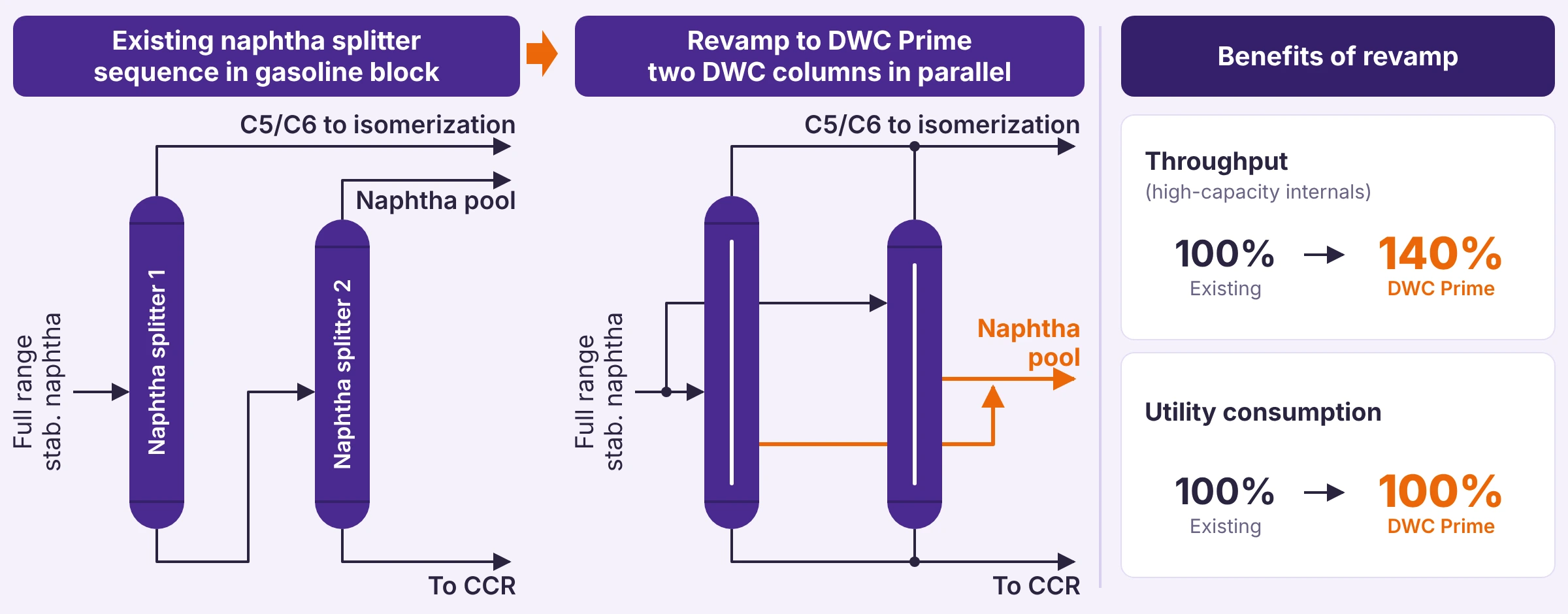
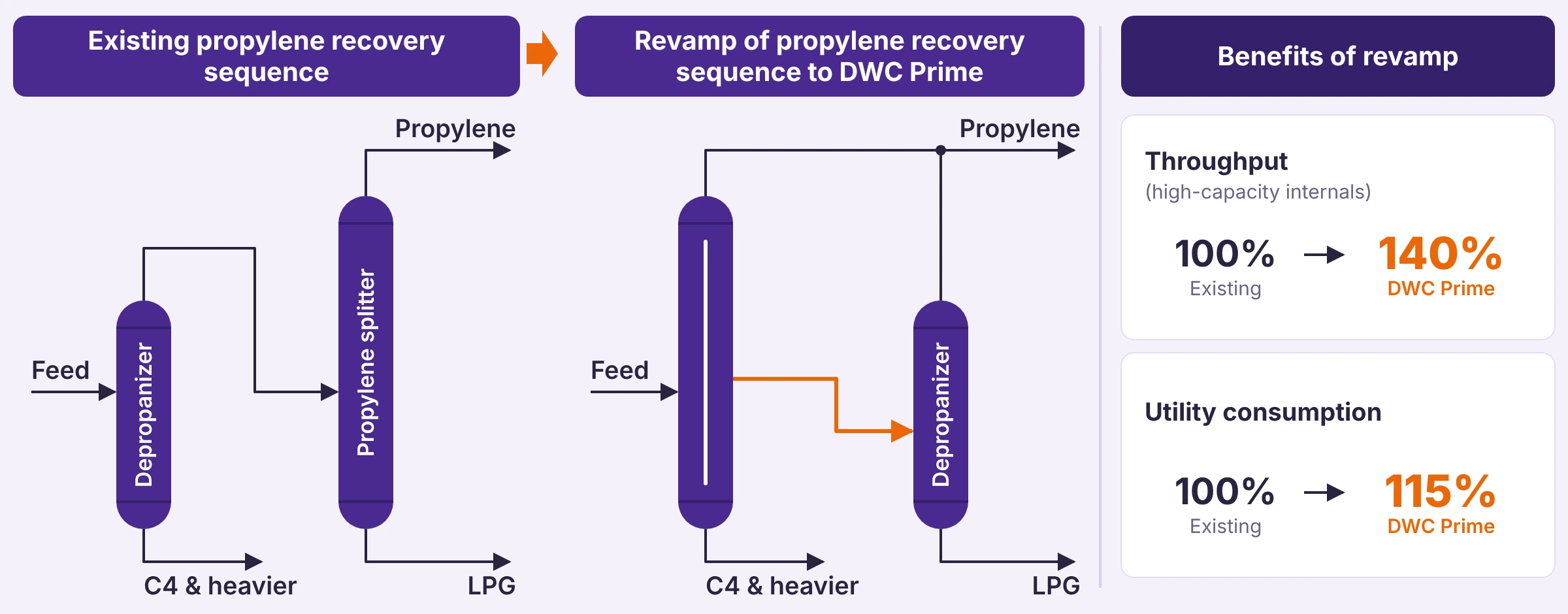
Step-change gains in product purity and throughput across common distillation sequences:
- Naphtha splitter sequence — a DWC Prime revamp adds more than 40% capacity over high-capacity internals, with changes limited to column internals and little or no modification to the reboiler, condenser or pumps.
- Depropanizer / propylene splitters — a ~30% throughput increase plus higher propylene recovery and lower RVP of the bottoms C4 product.
- Revamp for hexane product — converting the deisohexanizer to DWC Prime increases isomerization-unit feed capacity by 8–15%, while producing food-grade hexane as an added product with RON unchanged.
Separate more valuable product streams
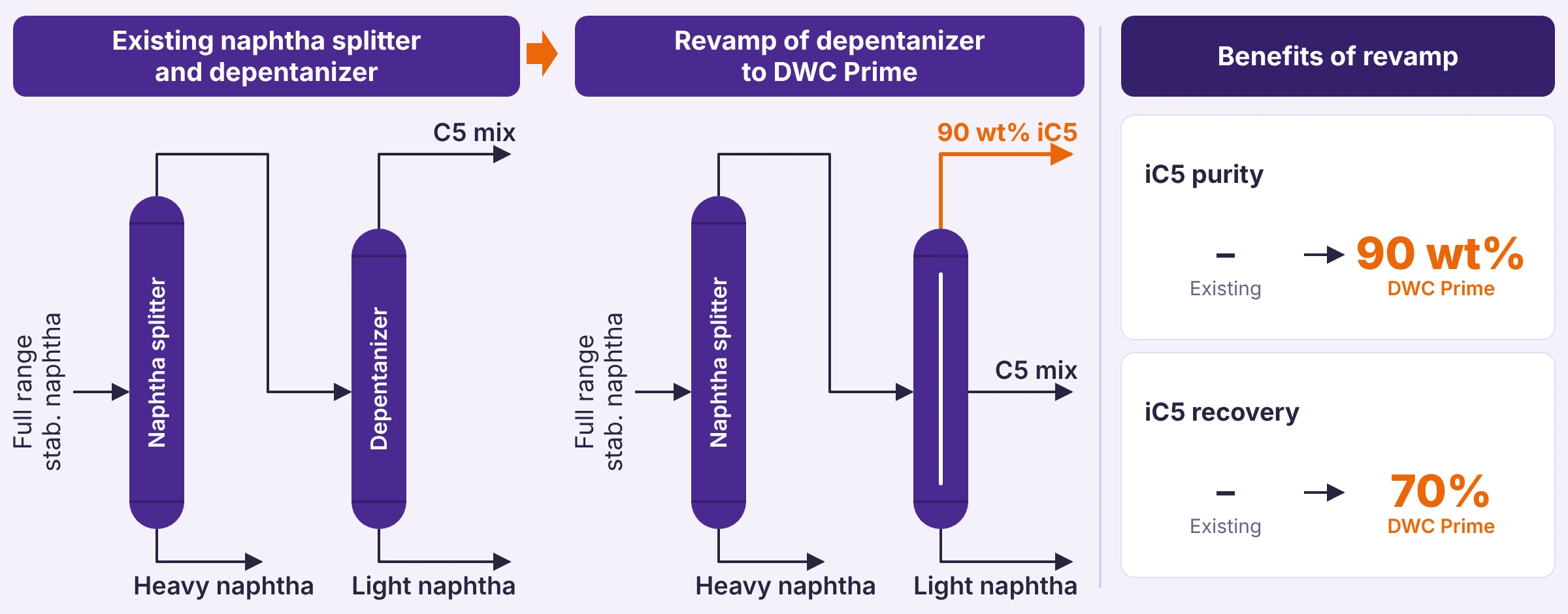
DWC Prime lets existing columns carve out higher-value cuts:
- Deisohexanizer (ISOM unit) — beyond light/heavy isomerate and the recycle to the reactor, a DIH revamp pulls a valuable fourth cut of food-grade hexane.
- Naphtha splitter / depentanizer — an extra product, 90%-purity isopentane at RON 90, ready to blend into premium gasoline.
Optimize integration between refinery and petrochemicals
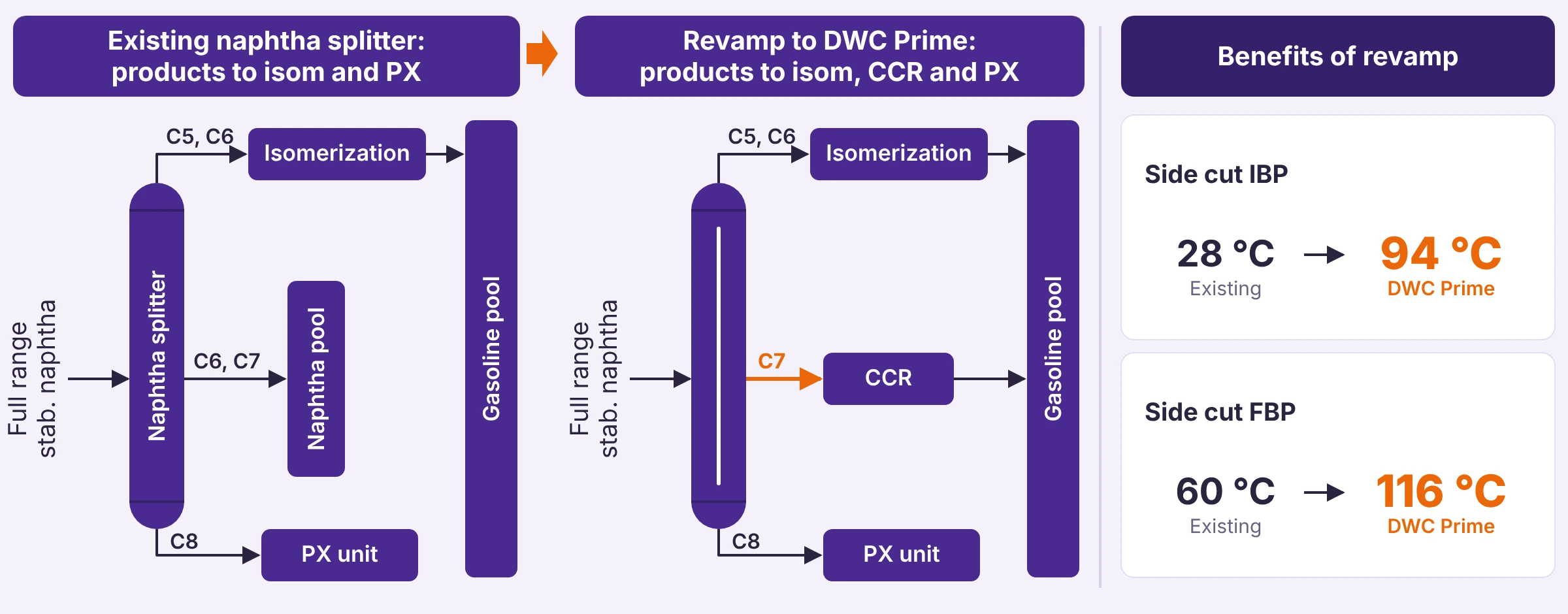
As new units are added over time, disposing of certain streams gets harder — for example a naphtha splitter whose top C5/C6 feeds isomerization and whose C8+ bottoms feed a para-xylene unit, leaving an awkward C6–C7 midcut.
A revamp to a dividing wall column delivers a cleaner C7 midcut suitable as CCR feed, improving specs and profitability across the block.
Debottleneck aromatic extraction via the reformate splitter
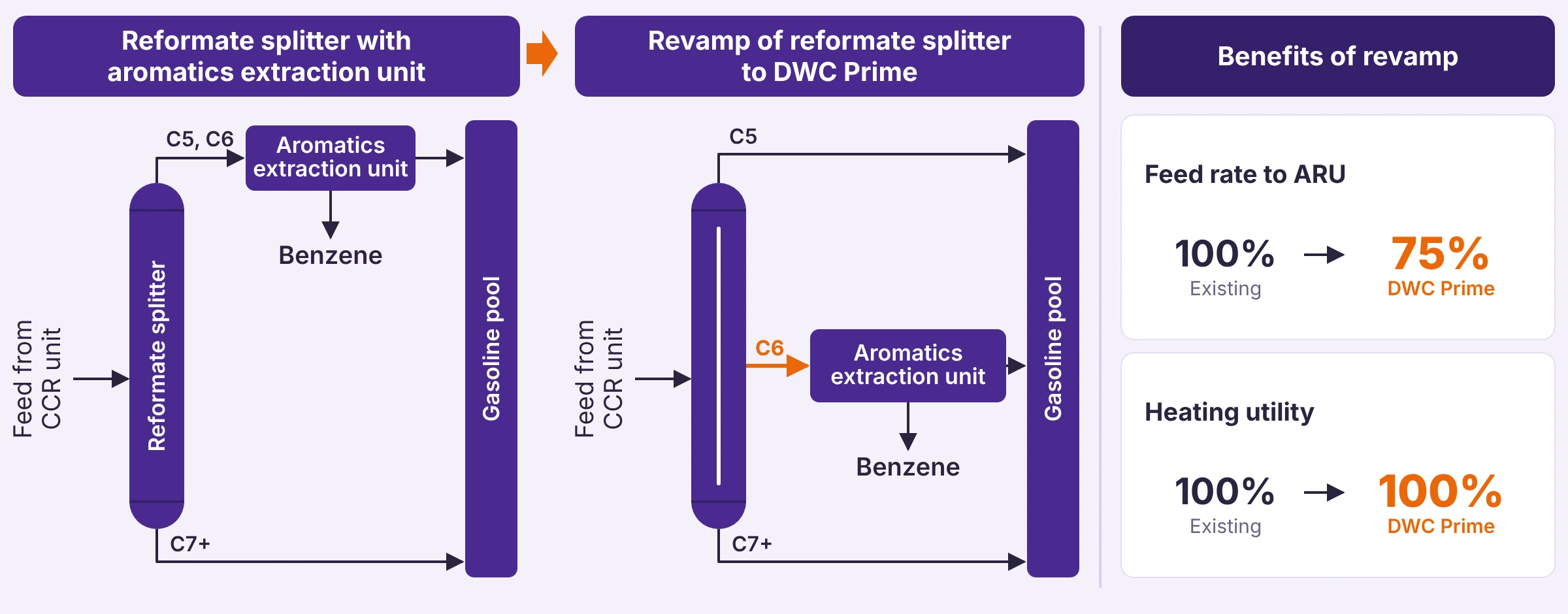
Benzene in the gasoline pool is usually managed with an aromatic extraction unit (AEU) or benzene saturation unit downstream of the reformate splitter, fed by its top C5–C6 cut.
A DWC revamp produces a concentrated C6 midcut that cuts feed to the AEU by at least 25% — freeing capacity downstream.
Optimize energy in refinery processes
We apply advanced energy-reduction techniques used across the industry:
- Heat-pump-assisted distillation — overhead vapor is compressed until it condenses hot enough to supply the reboiler duty; ideal for close-boiling separations such as propylene splitters.
- Multi-effect distillation — the vapor enthalpy of one column heats the reboiler of another — a powerful saver paired with DWC Prime where utility costs are high.
More capacity, no extra duty
See how a DWC Prime revamp of the naphtha splitters pushes around 40% more feed through the existing columns — with no increase in reboiler duty — while debottlenecking the downstream isomerization and CCR units.
- +40% capacity with reboiler duty unchanged
- Sharper cuts debottleneck the ISOM & CCR units
- Inside existing columns — ~$3M vs $15M, 20-day turnaround

Refinery process optimization: frequently asked questions
How much extra capacity does a DWC Prime revamp add to a naphtha splitter?
Typically more than 40% additional capacity, achieved by revamping only the column internals with little or no change to the reboiler, condenser, or pumps.
Can a propylene splitter be debottlenecked without adding a new column?
Yes — a dividing wall column revamp of a depropanizer/propylene splitter sequence can add roughly 30% more throughput and higher propylene recovery inside the existing shell.
What is a dividing wall column (DWC) revamp?
A DWC revamp installs a vertical partition inside an existing distillation column, letting one shell perform the work of two columns — adding capacity, sharpening product cuts, or recovering an extra product stream without major new equipment.
Want to boost profitability in your refinery?
Talk to our engineers about capacity increase, margin improvement, and energy-reduction opportunities in your refinery processes.